
 Customer Proof and Review Marketing PlatformLive
Turning Real Customer Reviews Into Branded Marketing Content That Helps New Customers Trust You Faster
ReviewProof Studio is a Technobita product. It imports real reviews from Google Business Profile and Trustpilot, adds brand and owner context, transforms the proof with AI into branded assets, and keeps every asset traceable to the review it came from.
AI can transform the proof. It should not invent the proof.
Product rhythm
- 01Proof
- 02Context
- 03Transformation
- 04Creative
- 05Reuse
Customer reviews should not stop creating value after they are published once.
Capture the proof. Preserve what made it real. Add useful context. Transform it for the channel. Keep the brand consistent. Publish responsibly.
Jump to section
The Problem
Businesses Have Proof. They Cannot Use It.
Real reviews exist across Google, Trustpilot, screenshots and inboxes. Collecting them is a solved problem. Turning them into consistent, branded, permissioned marketing content is not.
Proof is scattered and underused
Reviews live on different platforms in different formats. Most are seen once and never reused.
Generic AI lacks evidence
Ask a general AI tool for testimonial content and it will happily invent a customer. Marketing built on invented proof is worse than no marketing.
Design multiplies manual work
One review needs a social post, a story, a website block and an email snippet. Each format is manual work and each one risks drifting off brand.
Short reviews lack story, and agencies repeat everything
A five-word review has no context, and an agency managing many brands repeats the same workflow with different rules each time.
Permission and traceability are afterthoughts
Who said this, where, and can we publish it? Most workflows cannot answer, which makes responsible reuse impossible.
Collecting proof and activating proof are different jobs. Transform the proof. Do not manufacture the proof.
Product direction
A Proof-to-Marketing Workflow, Not a Copywriter
ReviewProof Studio is a proof-to-marketing operating workflow. It is not a generic AI copywriter, a review widget or a broad social media suite.
The review is the source of truth. It is imported once, structured once and reused many times. Transformation creates derivatives without rewriting the evidence underneath, brand context persists across jobs, and approval and permission are product states rather than good intentions.
Design principles
- Review is the source of truth. Import once, structure once, reuse the same source.
- Owner Voice adds real context from the business. It stays separate from the customer's words.
- AI behaviour is task-specific and generates only what the proof supports.
- Every asset stays linked to the proof it came from.
- Use AI to interpret and transform. Use software to preserve truth, ownership and workflow state.
Core Workflow
From Imported Review to Published Asset
The flagship workflow starts with real reviews and ends with branded assets that are approved, permissioned and still traceable to the source.
- 01Import or Capture
- 02Structure and Verify
- 03Organise and Select
- 04Brand Kit and Owner Voice
- 05AI Transform
- 06Branded Design
- 07Review and Approve
- 08Permission
- 09Publish, Export, Embed
- 10Reuse
- 01
- Import or CaptureGoogle Business Profile, Trustpilot, screenshots, files, manual entry.
- 02
- Structure and VerifyNormalise sources into one proof record. Confirm extracted data.
- 03
- Organise and SelectProof Library with filtering and selection.
- 04
- Brand Kit and Owner VoicePersistent brand context plus optional owner context.
- 05
- AI TransformTask-specific, proof-grounded content generation.
- 06
- Branded DesignTemplates and multi-format assets linked to the proof.
- 07
- Review and ApproveGenerated is not approved. Approved is not published.
- 08
- PermissionConsent state recorded per proof.
- 09
- Publish, Export, EmbedWall of Review, embeds and exports.
- 10
- ReuseThe same proof feeds the next job.
Workflow rules
- Import states are visible and duplicates are handled carefully.
- Screenshot extraction is always followed by user confirmation.
- Customer voice and owner voice never merge.
- Bulk and agency workflows preserve traceability and brand separation.
Capture once. Preserve the source. Add real context. Transform intentionally. Design consistently. Review responsibly. Reuse everywhere the proof belongs.
What Technobita Built
What Technobita Built
The product is a system around generation, not a generation feature. These are the systems that exist today, grouped by the job they do.
01
Proof capture and structure
- Google Business Profile and Trustpilot integrations
- Source normalisation into a canonical proof record
- AI screenshot capture with user confirmation
- Manual, file and testimonial capture
- Proof Library with source traceability, filtering and selection
02
Context
- Brand and workspace context
- Brand Kit with logo colour extraction
- Owner Voice with transcript persistence
- Customer and owner source separation
03
Transformation and design
- AI review content generator with task-specific, proof-grounded generation
- Brand-tone writing with variants and refinement
- Design generation, templates and multi-format assets
- Source-to-design linkage and bulk content and design
04
Governance and publishing
- Review replies and approval workflows
- Consent and permission state
- Wall of Review and website embeds
- Agency multi-brand workflows, content management and export
Value comes from the system around generation. AI reduces manual entry. Human confirmation protects evidence.
Important Decisions
Decisions That Shaped the Product
Most of these decisions exist to keep the proof stronger than the automation built around it.
- 01
One canonical proof record across every source
Google, Trustpilot, screenshots and manual entries become the same kind of record with source metadata preserved, so everything downstream works the same way.
- 02
Treat Google and Trustpilot import as core infrastructure
When external proof is the starting point, import reliability is part of the core experience, not an integration bolted on.
- 03
Human confirmation after screenshot extraction
AI reads the screenshot and proposes a record. The user confirms it. Accurate capture and factual verification are separate responsibilities.
- 04
Customer voice, Owner Voice and brand context stay separate
Three layers of context go into generation, but they are never blended into one. The customer's words remain the customer's words.
- 05
AI transforms but does not authenticate
Generation is grounded in known information and limited to what the evidence supports. The product never asks the model whether a review is real.
- 06
Generation, approval and permission are three different states
A generated asset is not approved. An approved asset is not permissioned for publication. Permission state is governance, not universal legal clearance.
- 07
Assets are source-linked and asset edits never edit the proof
Every design and piece of copy points back to its review. Editing the derivative leaves the evidence untouched.
- 08
Agency brand isolation and AI context scoped to the selected brand
An agency can run the same workflow for many clients without one brand's context leaking into another's content.
Preserve the evidence. Keep attribution clear. Verify extracted data. Separate generation from approval. Separate approval from permission.
Architecture
AI and Proof Architecture
The architecture keeps truth with the application and uses AI to transform the representation of that truth. The intelligence can fail without the product losing the workflow.
Sources and canonical proof
- External source adapters with idempotent imports
- Normalisation into a canonical proof record with source metadata
- Separate integration connection state and sync state
Context and generation
- Screenshot image to AI candidate to user confirmation
- Controlled generation context per job, scoped to the selected brand
- Task-specific AI with structured output and application-level validation
Lineage, governance and publication
- Asset lineage from proof to generation to version to design
- Creative approval separate from proof permission
- Deterministic, authorised publication and public embeds that expose only an intentional representation
AI boundary
AI interprets and transforms
- Reading screenshots into candidate records
- Writing proof-grounded content in the brand's tone
- Adapting content across formats
- Proposing variants for refinement
Software keeps control of
- What the original review said and who said it
- Source provenance and asset lineage
- Approval and permission state
- What becomes public, and where
AI works from the proof. The proof does not become whatever the AI says it is. Generated content should have ancestry.
Real Product Interfaces
Inside ReviewProof Studio
Captures of the live product. Each image is labelled with its source and whether it shows real or demo data.
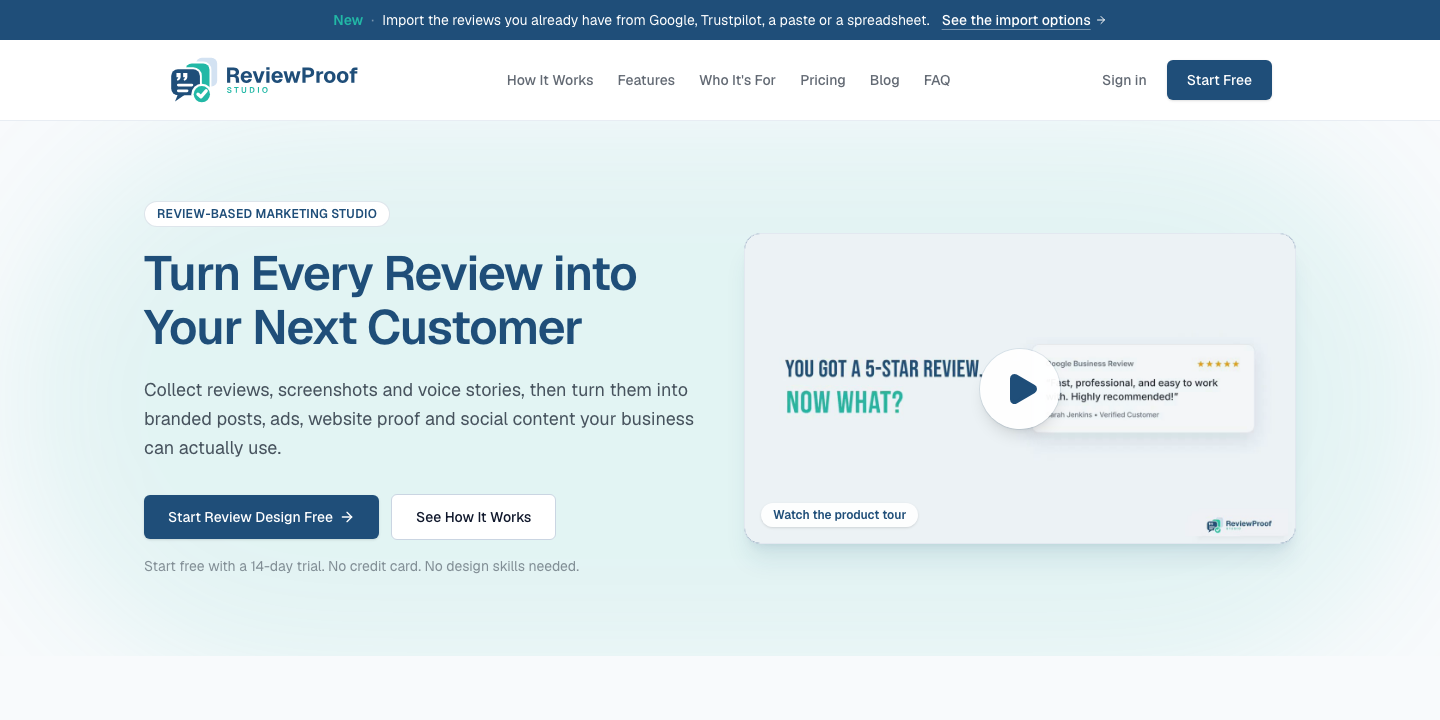
ReviewProof Studio public site, captured 1 October 2026 · reviewproofstudio.com ↗Real product UI
Challenges and Trade-Offs
Challenges and Trade-Offs
A product built around proof has to be careful with its own proof. These are the tensions that shaped the hardest decisions.
Authenticity versus AI transformation
Give AI creative freedom over expression without giving it creative freedom over facts. Direct quotes are preserved and unsupported claims are evaluated.
Screenshot convenience versus extraction accuracy
AI does the reading, the user does the confirming, and uncertainty can be represented in the record rather than hidden.
Integration breadth versus reliability
Reliable depth before integration breadth. Two flagship sources done properly outrank ten sources done loosely.
Brand consistency versus repetition
Persistent Brand Kit context keeps assets consistent while task-specific generation and variants keep them from becoming identical.
Bulk production versus quality control
Bulk jobs have item-level state and retry, with exception handling so one failure does not hide inside a batch.
Permission tracking versus legal overconfidence
Permission is contextual product state that proves governance. The product never claims it is universal legal clearance.
AI failure versus workflow continuity
Integration failures and AI failures are kept separate, and neither destroys workflow state.
Transform without inventing. Automate without hiding uncertainty. Scale without losing lineage. Brand without rewriting the customer.
Status and Evidence
Current Status and Evidence
A working feature proves product capability. It does not automatically prove customer adoption, business growth or marketing performance. The ladder is derived from our registries.
Evidence ladder
Status: LiveProduct Definition
Reached
The problem, users, workflow and product responsibility are defined.
Working Product
Reached
Core capabilities exist and function in the product.
Production Availability
Reached
Real users can access the product in a production environment.
Customer Usage
Next
Verified usage by customers, not only internal testing.
Commercial Evidence
Not yet
Verified paying customers or commercial traction.
Verified Outcomes
Not yet
Measured business outcomes with evidence behind them.
- Google and Trustpilot imports need recent end-to-end verification before any integration claim is treated as current.
- Demo reviews and demo businesses prove product behaviour only and are labelled as demo data.
- No before-and-after outcome claims, time-saving figures or conversion metrics are published without verified evidence.
Current Direction
ReviewProof Studio is live. The priorities below deepen the proof workflow before widening the marketing platform.
- 01Stabilise Google Business Profile and Trustpilot imports
- 02Shorten time to first usable asset
- 03Improve proof organisation in the library
- 04Strengthen AI grounding and evaluation
- 05Improve Owner Voice and deepen creative quality across formats
- 06Build safer bulk workflows and stronger agency multi-brand and approval workflows
- 07Improve permission and public-proof handling
- 08Expand integrations or publishing only when real demand justifies it
The flagship workflow should be the most dependable workflow in the product. Depth around proof before breadth across marketing.
What We Learned
What We Learned
ReviewProof Studio taught us more about grounded AI products than any other project. These are the lessons we reuse.
Structure proof as product data before it becomes AI context
Normalising external complexity at the product boundary made every later step simpler and safer.
Persistent context beats repeated prompting
A Brand Kit and Owner Voice that persist make the product more useful than any chatbot, and better context is not the same as more context.
Grounding must preserve meaning, evidence and speaker attribution
Knowing what was said and who said it is a requirement, not a nice-to-have, and it needs explicit evaluation.
Generated derivatives need lineage
Keeping product truth outside the model and linking every asset back to its proof is what makes responsible reuse possible.
Automation moves the bottleneck
When AI removes one bottleneck, look for the next one. Bulk AI requires workflow engineering, not just a bigger button.
Human control belongs in workflow transitions
Review matters most near durable truth or irreversible action. Approval and permission are distinct, and both are human decisions.
AI product quality is a chain and the model is only one link in that chain. Improve the information going into intelligence before assuming the solution is more intelligence.
Capabilities Demonstrated
Capabilities Demonstrated
ReviewProof Studio demonstrates how Technobita structures a problem, designs the right workflow and engineers the AI and software system around it.
Product Thinking
Define the user problem, product responsibility and useful scope before implementation expands.
SaaS Architecture
Design the application foundation required for accounts, workspaces, permissions, data and product workflows.
External Integration Engineering
CoreConnect external systems with validation, failure handling and clear ownership of data.
Data Normalisation
Transform information from different sources into consistent structures the application can use reliably.
Multimodal AI
CoreUse AI with text, images, documents, audio or mixed inputs where the product workflow requires it.
AI Data Extraction
Use AI to extract useful structured information from unstructured source material.
Context Engineering
CoreAssemble the relevant product, user, workspace and task context an AI capability needs to perform its job.
Source-Aware Context
Preserve where information came from so AI behaviour can remain connected to its underlying sources.
Grounded AI
Generate or interpret information using defined source material rather than relying on unsupported model invention.
Human-in-the-Loop Design
Keep human confirmation, review or judgment inside workflows where the consequence of error requires it.
Provenance Architecture
CorePreserve the origin and transformation history of important information and generated assets.
Asset Lineage
Track how derived assets relate back to their source information and prior transformations.
Multi-Brand Architecture
Keep brand-specific data, configuration and assets isolated inside shared software.
Brand Context Systems
Represent reusable brand information so generated product output can remain context-aware and consistent.
Programmatic Creative Systems
CoreGenerate repeatable branded creative outputs from structured content and design rules.
Multi-Format Design
Adapt structured content into multiple useful output formats while preserving design consistency.
Approval Workflows
Design clear transitions between creation, review, correction and approval.
Evidence Discipline
Keep capability, usage, commercial and outcome claims aligned with the strength of available evidence.
Related work
Chosen by shared capability, not by what we want to advertise. Different products, same transferable judgment.
Promptelligence
AI Prompt Intelligence SaaS
Promptelligence transforms rough ideas into structured high-quality prompts tailored to the user's chosen AI task type and desired level of depth.
Shared: Product Thinking, SaaS Architecture, Context Engineering
Read the story →
BossBoard
SOP-Based Staff Accountability Platform
BossBoard helps small business owners know who completes work properly, not just who marks tasks done.
Shared: Product Thinking, SaaS Architecture, Approval Workflows
Read the story →
Start with the real workflow
Have Valuable Data or a Repetitive Workflow That Still Takes Too Much Manual Work?
Technobita helps businesses, SaaS founders and agencies turn difficult workflows into practical software systems that combine structured data, AI assistance and clear human control where those capabilities genuinely improve the work.
You do not need a complete specification or AI architecture. Start with the problem, the information involved, the people doing the work and what currently takes too much time or breaks too easily.
Good AI products do more than generate impressive outputs. They understand where information comes from, preserve what matters, automate the right work and keep people in control of the decisions that still belong to them.