
 SOP-Based Staff Accountability PlatformLive
Know Who Completes Work Properly, Not Just Who Marks Tasks Done
BossBoard is a Technobita product. It connects every task to a person, a role, an SOP, a proof requirement and a fair review, then turns reviewed work into a reliability signal owners can trust.
Accountability without employee surveillance.
Product rhythm
- 01Structure
- 02Responsibility
- 03Execution
- 04Review
- 05Pattern
Accountability OS. Built and operated by Technobita.
Define responsibility. Set the expectation. Review the work. Understand the pattern.
Jump to section
The Problem
A Ticked Box Is Not Evidence That Work Was Done Well
Small business owners rely on task tools that record completion, not quality. The result is a list of green ticks and no real picture of who they can depend on.
Done does not equal quality
Marking a task complete says nothing about whether it followed the procedure or met the standard.
Fair accountability starts before the work
If the expectation was never defined, judging the result afterwards is unfair to the person and useless to the owner.
Reliability is a pattern, not an incident
One good or bad task tells you little. Owners need to see repeated, reviewed work over time.
Accountability should not require surveillance
Screen recording and activity tracking damage trust. The alternative is clear expectations and reviewed proof of the actual work.
Define what good looks like first. Then review real work against it.
Product direction
An Accountability Loop, Not Another Task List
BossBoard connects organisation structure, responsibility, SOPs, tasks, proof, review, correction and reliability into one workflow.
Instead of adding features to a to-do app, the product is designed as a loop. Structure defines responsibility, responsibility defines the expectation, proof shows the execution, review judges it fairly, and the pattern of reviewed work becomes reliability.
Design principles
- Positions carry responsibility. People fill positions.
- Every task links to an SOP so the expectation exists before the work.
- Proof is attached to the task, not collected by watching the employee.
- Review is a defined step with a fair scoring model, not an opinion.
- AI can assist accountability. Humans make consequential decisions.
Core Workflow
From Org Chart to Operational Insight
The workflow is longer than a task tool because accountability needs more context. Each step adds the information the next one depends on.
- 01Org Chart
- 02Position
- 03Person
- 04SOP
- 05Task
- 06Proof
- 07Review
- 08Approve or Correct
- 09Reliability
- 10Improvement
- 01
- Org ChartBusiness structure and departments.
- 02
- PositionRoles with defined responsibilities.
- 03
- PersonThe individual filling the position.
- 04
- SOPHow the work should be done.
- 05
- TaskA specific piece of work assigned against the SOP.
- 06
- ProofEvidence attached to the completed task.
- 07
- ReviewFair scoring against the expectation.
- 08
- Approve or CorrectOutcome and correction tracking.
- 09
- ReliabilityPattern of reviewed work over time.
- 10
- ImprovementOperational insight for owners and teams.
Workflow rules
- A task cannot exist without a position and an SOP behind it.
- Proof belongs to the work, never to monitoring the person.
- Reliability is calculated from reviewed outcomes, not from activity.
What Technobita Built
What Technobita Built
BossBoard is a multi-tenant SaaS application with a structured data model and a review workflow at its centre. These are the current systems.
01
Structure and responsibility
- Role-based org chart with departments and positions
- SOP builder with steps and acknowledgements
- Workspace, access and role-specific dashboards
02
Execution and proof
- Proof-based tasks linked to SOPs
- File storage for proof attachments
- Notifications and activity logs
03
Review and reliability
- Review queue with fair review scoring
- Correction tracking as a first-class outcome
- Reliability dashboard built from reviewed work
- Setup guide to shorten time to a working structure
The value is in how the systems connect. Each one alone is a feature. Together they form an accountability loop.
Important Decisions
Decisions That Shaped the Product
These decisions define BossBoard. Several of them are the reason it is not a generic task manager.
- 01
Positions are not people
Responsibility belongs to the position. People change, go on leave or get promoted. Modelling this separately keeps the structure stable and the history correct.
- 02
Done is not approved
Completion and approval are different states. Treating them as one is how task tools lose the quality signal.
- 03
Proof is not surveillance
The product asks for evidence of the work output. It never watches the person doing it.
- 04
Correction is first-class
A correction is valuable information about the SOP, the training or the task, not a punishment record.
- 05
Reliability comes from repeated reviewed work
A score built from many fair reviews over time is meaningful. A score built from activity or self-reporting is not.
- 06
AI assists before consequential judgment
AI is most useful upstream, helping write SOPs or clarify tasks. Decisions that affect people stay with people.
Architecture
A Deterministic Core With AI Kept Outside It
The accountability loop is a state machine. It has to be predictable, explainable and fair. AI is positioned around it, not inside it.
Tenancy, identity and access
- Workspace multi-tenancy
- Authentication identity separate from organisational person and role
- Data-layer access control by role and position
Structured accountability data
- Organisation, SOP, task, proof, review and correction records
- Explicit state transitions from assigned to reviewed
- Deterministic reliability calculations from reviewed outcomes
AI assistance layer (planned)
- SOP drafting and task clarity support
- Proof review support and correction suggestions
- Reliability insights that explain, not decide
AI boundary
AI interprets and transforms
- Drafting and improving SOP text
- Flagging unclear task definitions
- Summarising patterns for a human reviewer
Software keeps control of
- Who is responsible for what
- Task, proof and review state
- How reliability is calculated
- Who can see and change each record
Use AI where intelligence helps. Use software rules where certainty matters.
Real Product Interfaces
Inside BossBoard
Captures of the live product. Each image is labelled with its source and whether it shows real or demo data.
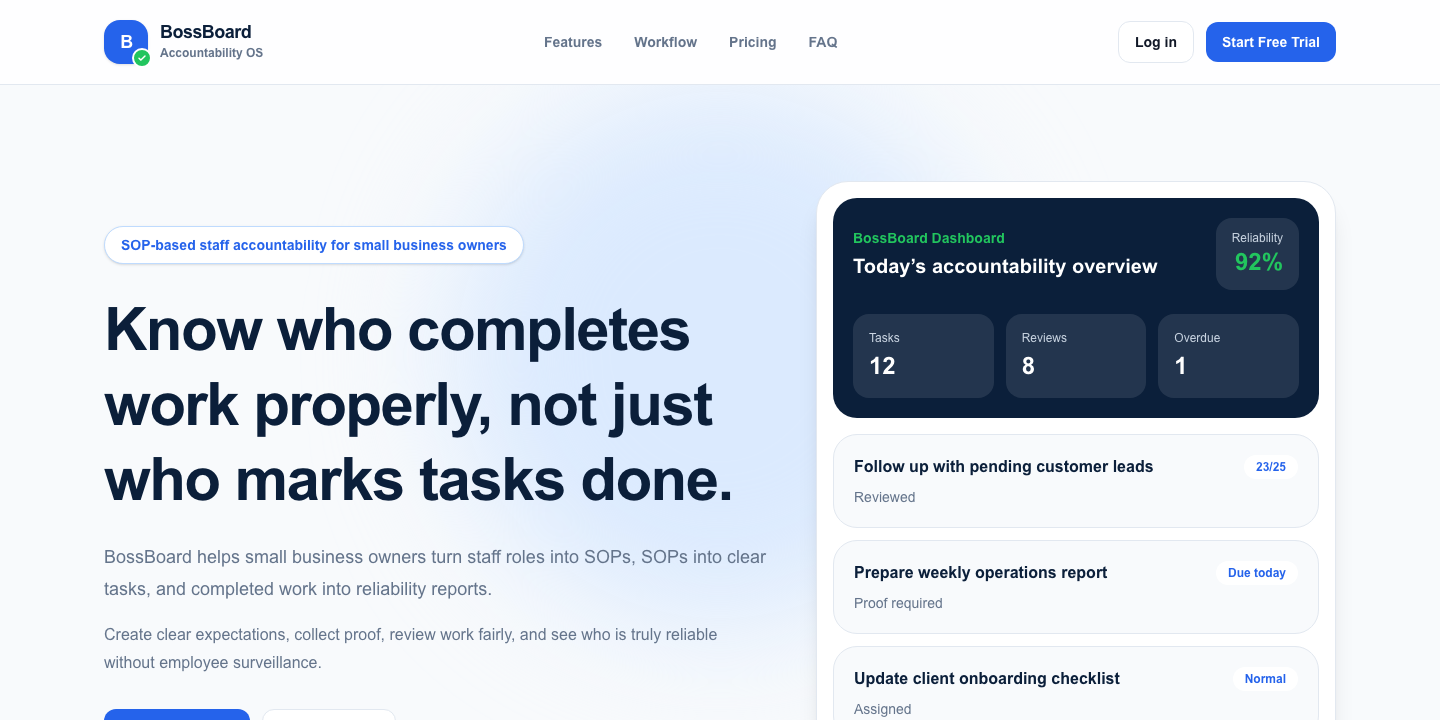
BossBoard public site, captured 1 October 2026 · bossboard.io ↗Real product UI
Challenges and Trade-Offs
Challenges and Trade-Offs
Accountability products fail when they become bureaucracy or surveillance. Most of the design effort went into avoiding both.
Structure versus bureaucracy
The setup guide gets a business to a working org chart and first SOPs quickly, and the structure only needs to be as deep as the business actually is.
Proof versus surveillance
Proof is a requirement on the task output. The product has no activity tracking, screenshots or monitoring of any kind.
Review consistency versus context
Fair review scoring gives reviewers a shared model while corrections capture the context a score cannot.
Reliability versus false precision
Reliability is shown as a pattern built from reviewed work, with the reviews visible underneath it, rather than as a single authoritative number.
Corrections versus punishment
Corrections are framed and stored as improvement information linked to the SOP and task, not as disciplinary records.
Deterministic signal versus AI interpretation
The reliability signal is deterministic. AI, when added, explains and assists but never alters the underlying calculation.
Status and Evidence
Current Status and Evidence
The ladder below is derived from our product and evidence registries. We do not imply later stages without support.
Evidence ladder
Status: LiveProduct Definition
Reached
The problem, users, workflow and product responsibility are defined.
Working Product
Reached
Core capabilities exist and function in the product.
Production Availability
Reached
Real users can access the product in a production environment.
Customer Usage
Next
Verified usage by customers, not only internal testing.
Commercial Evidence
Not yet
Verified paying customers or commercial traction.
Verified Outcomes
Not yet
Measured business outcomes with evidence behind them.
- Working-product evidence reflects the capabilities that exist today.
- Customer usage, commercial and outcome evidence appear only when verified.
- Demo data in any interface is labelled as demo data, never as customer results.
Current capability records
- Role-Based Org Chart
- SOP Builder
- Proof-Based Tasks
- Fair Review Scoring
- Reliability Dashboard
- Correction Tracking
- Setup Guide
- No Employee Surveillance
Current Direction
BossBoard is live. The priorities below are current. AI capabilities are planned and stay labelled as planned until verified.
- 01Strengthen the accountability loop from SOP to reliability
- 02Reduce setup time for a new business
- 03Improve review quality and consistency
- 04Make reliability more explainable to owners and staff
- 05Add AI assistance in sequence: setup guidance, SOP assistant, task clarity, correction suggestions, proof review support, reliability insights (planned)
- AI SOP Assistant · Planned
- AI Task Clarity Checker · Planned
- AI Proof Review Support · Planned
- AI Reliability Insights · Planned
- AI Correction Suggestions · Planned
- AI Setup Guidance · Planned
AI assists. Humans decide.
What We Learned
What We Learned
These lessons apply to any workflow product where people, expectations and evidence meet.
Accountability begins before the task
If responsibility and the expected standard are not defined first, nothing downstream can be fair.
The SOP has to participate in execution
An SOP stored in a document is ignored. An SOP attached to the task shapes how the work is done.
Proof should serve the work
Asking for proof that helps the next step is accepted. Asking for proof to monitor people is resented.
Corrections are valuable
Patterns in corrections point at unclear SOPs and training gaps faster than any dashboard.
AI is most useful upstream
Helping people define work clearly prevents more problems than judging work afterwards.
Uncertainty should be surfaced
When a signal is thin, say so. A confident number built on two reviews misleads everyone.
Show the problem. Show the decision. Show the workflow. Show the system. Let the capability become visible through the work.
Capabilities Demonstrated
Capabilities Demonstrated
BossBoard shows how Technobita turns a people-and-process problem into a structured system. These capabilities transfer directly to custom business software.
Product Thinking
Define the user problem, product responsibility and useful scope before implementation expands.
Workflow Design
CoreTurn real business or product processes into understandable states, actions and responsibilities.
SaaS Architecture
CoreDesign the application foundation required for accounts, workspaces, permissions, data and product workflows.
Product Data Architecture
Model product information, ownership and relationships so application state remains understandable and dependable.
Product State Architecture
CoreRepresent important workflow and product conditions as explicit application state rather than implicit assumptions.
Governance State Design
Represent approval, permission and operational governance as explicit product state.
Approval Workflows
Design clear transitions between creation, review, correction and approval.
Privacy-Aware Engineering
CoreDesign data collection, access and processing around the information the product genuinely needs.
Trust-Aware Design
Make product state, evidence, responsibility and important limitations understandable to users.
Related work
Chosen by shared capability, not by what we want to advertise. Different products, same transferable judgment.

ReviewProof Studio
Customer Proof and Review Marketing Platform
ReviewProof Studio helps businesses turn real customer reviews into trust-building marketing content.
Shared: Product Thinking, SaaS Architecture, Approval Workflows
Read the story →
Promptelligence
AI Prompt Intelligence SaaS
Promptelligence transforms rough ideas into structured high-quality prompts tailored to the user's chosen AI task type and desired level of depth.
Shared: Product Thinking, SaaS Architecture
Read the story →
Have a workflow that needs a real system?
Build Software Around the Way Your Business Actually Works
Technobita builds custom business software and SaaS products around real workflows, responsibilities and the state that has to stay predictable.
Understand the workflow. Define the responsibility. Build the missing system. Preserve the evidence. Automate carefully. Improve from real usage.