
 AI Prompt Intelligence SaaSLive
Turning Rough Intent Into Structured Instructions AI Understands Better
Promptelligence is a Technobita product. It takes a rough idea, the task you want to do and the depth you need, then produces a structured prompt, scores the improvement and lets you refine it in plain English.
Better prompts, not just longer prompts. You know what you want. The product helps you tell AI properly.
Product rhythm
- 01Rough Intent
- 02Structured Prompt
- 03Evaluated
- 04Refined
Built and operated by Technobita as one of our own SaaS products.
Jump to section
The Problem
Most Prompts Fail Before the Model Ever Answers
People know what they want from AI. Turning that intent into instructions a model can act on reliably is the hard part, and most tools leave it entirely to the user.
Vague prompts produce vague results
A rough sentence leaves the model to guess the task, the audience, the format and the level of depth. The result is inconsistent and often needs several retries.
Quality is invisible
Users cannot tell whether a prompt is good before they run it. They only see the output and have no signal about what to change.
Good prompts get lost
A prompt that worked well disappears into a chat history. The next time, the person starts from scratch and gets a different result.
Refinement means starting over
Adjusting one aspect of a prompt usually means rewriting the whole thing, which is slow and discards what already worked.
The gap is not model capability. It is the quality of the instruction the model receives.
Product direction
Prompt Intelligence, Not a Prompt Library
Promptelligence transforms rough ideas into structured, high-quality prompts tailored to the chosen AI task type and the desired level of depth.
A library of other people's prompts does not solve the user's actual problem, which is expressing their own intent well. So the product is built around transformation, evaluation and refinement of the user's own idea rather than around browsing templates.
Design principles
- Start from the user's rough idea, not from a catalogue.
- Let the user choose the task type and depth so the structure fits the job.
- Show how much stronger the prompt became, with a before and after score.
- Allow adjustment in plain English without restarting.
- Keep the best prompts so they do not disappear after one conversation.
Core Workflow
From Rough Idea to Reusable Prompt
The core workflow is deliberately short. Each step has one job, and the user stays in control of the result at every point.
- 01Rough Idea
- 02Choose Task and Depth
- 03Structure
- 04Evaluate
- 05Refine
- 06Save and Reuse
- 01
- Rough IdeaThe user writes what they want in their own words.
- 02
- Choose Task and DepthTask type plus Smart, Deep Think or Elite enhancement level.
- 03
- StructureThe idea becomes a structured prompt for that task.
- 04
- EvaluateBefore and after scoring shows the improvement.
- 05
- RefineAdjust in plain English without starting again.
- 06
- Save and ReuseTemplates, library and workspaces keep the result.
Workflow rules
- The user's original idea is always preserved alongside the structured version.
- Depth is a user choice, not something the system silently decides.
- Refinement edits the structured prompt. It does not regenerate from zero.
What Technobita Built
What Technobita Built
The product is a complete SaaS application, not a single prompt call. These are the current systems. Planned capabilities are listed separately in Current Direction and stay labelled as planned until verified.
01
Prompt transformation
- Rough idea to structured prompt transformation
- Smart, Deep Think and Elite enhancement levels
- Task-type aware structuring
02
Quality and evaluation
- Before and after prompt scoring
- Built-in quality evaluation
- Natural-language refinement without restarting
03
Product foundation
- Prompt Templates
- Prompt Library
- Workspaces foundation
- Accounts, access and product state
The transformation is one feature. The product is the system that makes the transformation useful, measurable and reusable.
Important Decisions
Decisions That Shaped the Product
These are the product and engineering choices that mattered most. Each one closed off an easier but weaker option.
- 01
Structured transformation instead of free rewriting
A free rewrite can make a prompt longer without making it better. Structuring around task type and depth gives the model a defined shape to work towards and gives the user something they can inspect.
- 02
Evaluate the prompt, not only the answer
Scoring the prompt before and after transformation gives users a signal they can act on before spending time and tokens on output.
- 03
Refinement stays in the user's hands
The system proposes. The user adjusts in plain language until it feels right. This keeps intent with the person who has it.
- 04
Depth levels are explicit
Smart, Deep Think and Elite make cost, time and thoroughness a visible choice rather than a hidden setting.
- 05
Persistence is part of the core, not an add-on
Templates, a library and workspaces exist because a good prompt that cannot be found again has limited value.
Architecture
AI Architecture With Clear Boundaries
The model does the interpretation and generation. Everything that must stay predictable, including user data, product state and what counts as a valid result, is handled by the application.
Context and input contract
- User idea and selected task type
- Chosen enhancement level
- Task-specific instructions and output schema
Transformation and evaluation
- Structured prompt generation for the task
- Quality evaluation and before/after scoring
- Refinement from natural-language feedback
Validation and product state
- Structured output validation before display
- Versioned prompt records in the user's library
- Workspace, access and ownership rules
AI boundary
AI interprets and transforms
- Interpreting the rough idea
- Producing the structured prompt
- Scoring and explaining quality
- Applying refinement requests
Software keeps control of
- Who owns which prompt
- What a valid output looks like
- Saving, versioning and reuse
- Cost limits per enhancement level
Use AI where interpretation and generation help. Keep ownership, validation and state under software control.
Real Product Interfaces
Inside Promptelligence
Captures of the live product. Each image is labelled with its source and whether it shows real or demo data.
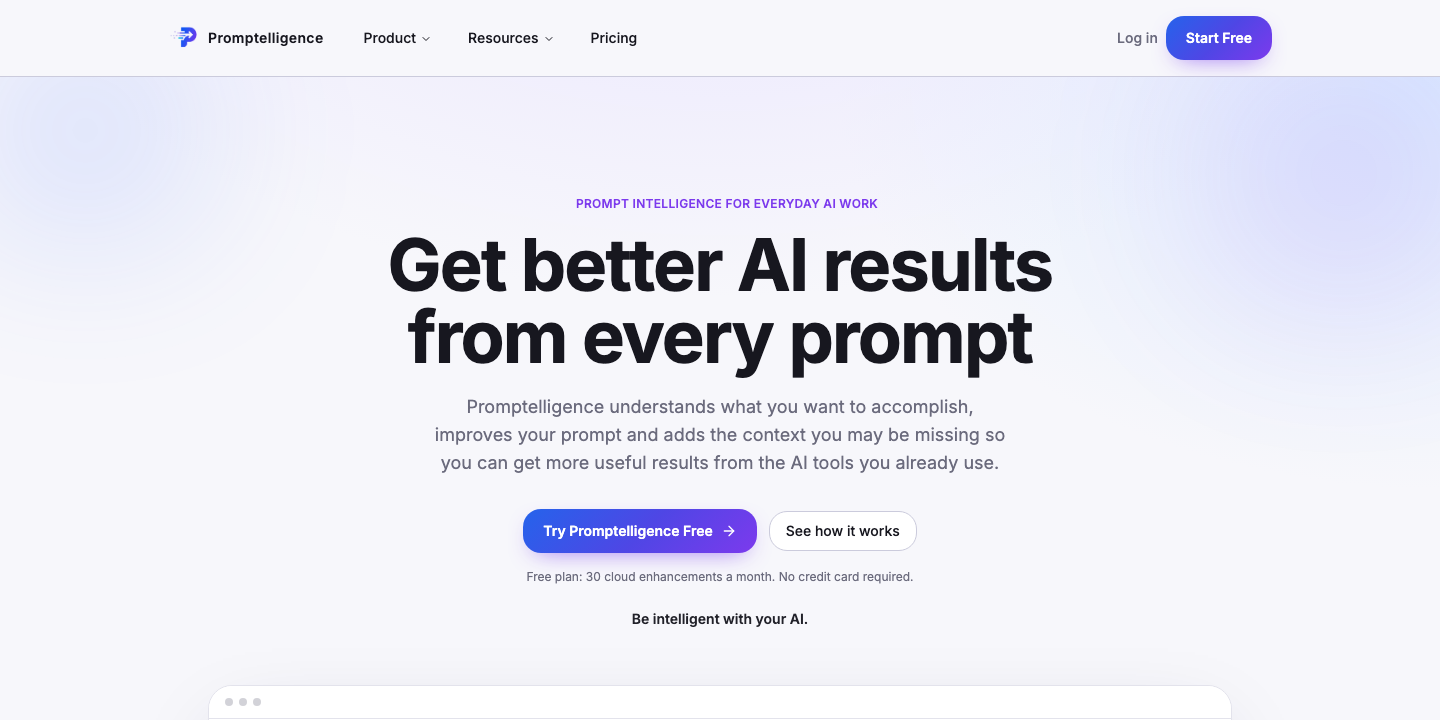
Promptelligence public site, captured 1 October 2026 · promptelligence.io ↗Real product UI
Challenges and Trade-Offs
Challenges and Trade-Offs
A prompt product has a specific set of tensions. These are the ones we spent the most time on.
Useful depth versus unnecessary verbosity
Depth is tied to the enhancement level the user chose. A longer prompt is only produced when the user asked for more thorough work.
Structured output versus formulaic results
Structure is task-specific rather than one universal template, so a research prompt and a writing prompt do not come out looking the same.
Evaluation versus false certainty
Scores are presented as a comparison of before and after, not as a guarantee of output quality. The user can still judge and refine.
Refinement flexibility versus losing what worked
Refinement applies to the existing structured prompt and the earlier version remains available, so improvements are not lost.
Status and Evidence
Current Status and Evidence
We separate evidence that the product works from evidence about usage and outcomes. The ladder below is derived from our registries, not written by hand.
Evidence ladder
Status: LiveProduct Definition
Reached
The problem, users, workflow and product responsibility are defined.
Working Product
Reached
Core capabilities exist and function in the product.
Production Availability
Reached
Real users can access the product in a production environment.
Customer Usage
Next
Verified usage by customers, not only internal testing.
Commercial Evidence
Not yet
Verified paying customers or commercial traction.
Verified Outcomes
Not yet
Measured business outcomes with evidence behind them.
- Working-product evidence comes from the capabilities that exist and function today.
- Usage, commercial and outcome evidence only appear once they are verified and recorded.
- Planned capabilities never count as evidence.
Current capability records
- Rough Idea to Structured Prompt Transformation
- Smart, Deep Think and Elite Enhancement Levels
- Before and After Prompt Scoring
- Built-In Quality Evaluation
- Natural-Language Refinement
- Prompt Templates
- Prompt Library
- Workspaces Foundation
Current Direction
Promptelligence is live with a free plan. The priorities below are what we are working on now. Anything planned stays labelled as planned until it is verified in the product.
- 01Strengthen the core transformation and evaluation loop
- 02Improve how templates and the library support repeated work
- 03Extend to dedicated image and video prompt modes (planned)
- 04Optimise prompts for specific target AI systems (planned)
- 05Deeper brand context for consistent prompts across a team (planned)
- Dedicated Image Mode · Planned
- Dedicated Video Mode · Planned
- Target-AI Optimisation · Planned
- Deeper Brand Context · Planned
One place to create better prompts for text, images and video, built one verified capability at a time.
What We Learned
What We Learned
The lessons below transfer to other AI products. They are about prompt quality, context and evaluation rather than about this product alone.
Prompt quality is a product problem, not a user problem
Expecting users to become prompt engineers does not scale. Encoding good structure into the product does.
Context beats cleverness
Knowing the task type and depth improved results more than any amount of generic prompt wizardry.
Evaluation needs to be visible to be useful
A quality signal the user can see changes behaviour. A hidden score changes nothing.
Iteration should preserve work
Users refine more when adjusting is cheap and nothing is lost. Regenerating from scratch discourages improvement.
Improve the instruction going into the model before assuming the answer is a bigger model.
Capabilities Demonstrated
Capabilities Demonstrated
The product decisions above map to capabilities Technobita applies to client work. Each one is visible through the product rather than claimed in the abstract.
Product Thinking
CoreDefine the user problem, product responsibility and useful scope before implementation expands.
SaaS Architecture
Design the application foundation required for accounts, workspaces, permissions, data and product workflows.
Context Engineering
CoreAssemble the relevant product, user, workspace and task context an AI capability needs to perform its job.
Task-Specific AI
Give AI a defined responsibility inside a workflow rather than using intelligence without clear boundaries.
Structured AI Output
CoreProduce machine-usable AI results that software can parse, inspect and validate.
AI Output Validation
Check AI results against required schemas, constraints and product rules before downstream use.
AI Evaluation
CoreEvaluate AI behaviour against defined product expectations and representative cases.
Scope Discipline
Prioritise the smallest useful product scope that reduces meaningful uncertainty without unnecessary complexity.
Related work
Chosen by shared capability, not by what we want to advertise. Different products, same transferable judgment.

ReviewProof Studio
Customer Proof and Review Marketing Platform
ReviewProof Studio helps businesses turn real customer reviews into trust-building marketing content.
Shared: Product Thinking, SaaS Architecture, Context Engineering
Read the story →
BossBoard
SOP-Based Staff Accountability Platform
BossBoard helps small business owners know who completes work properly, not just who marks tasks done.
Shared: Product Thinking, SaaS Architecture
Read the story →
Have an AI product idea?
Turn an AI Idea Into a Product People Can Actually Use
Technobita helps founders and businesses take an AI idea, prototype or existing product and build the workflow, architecture and controls around it.
You do not need a finished specification. Start with the problem, the user and what the AI needs to accomplish.