
Why an AI Demo Is Easier Than an AI SaaS Product
An AI demo proves that a model can do something once. A product has to do it for real users, with real data, every day. Here is where the gap is and how we cross it at Technobita.
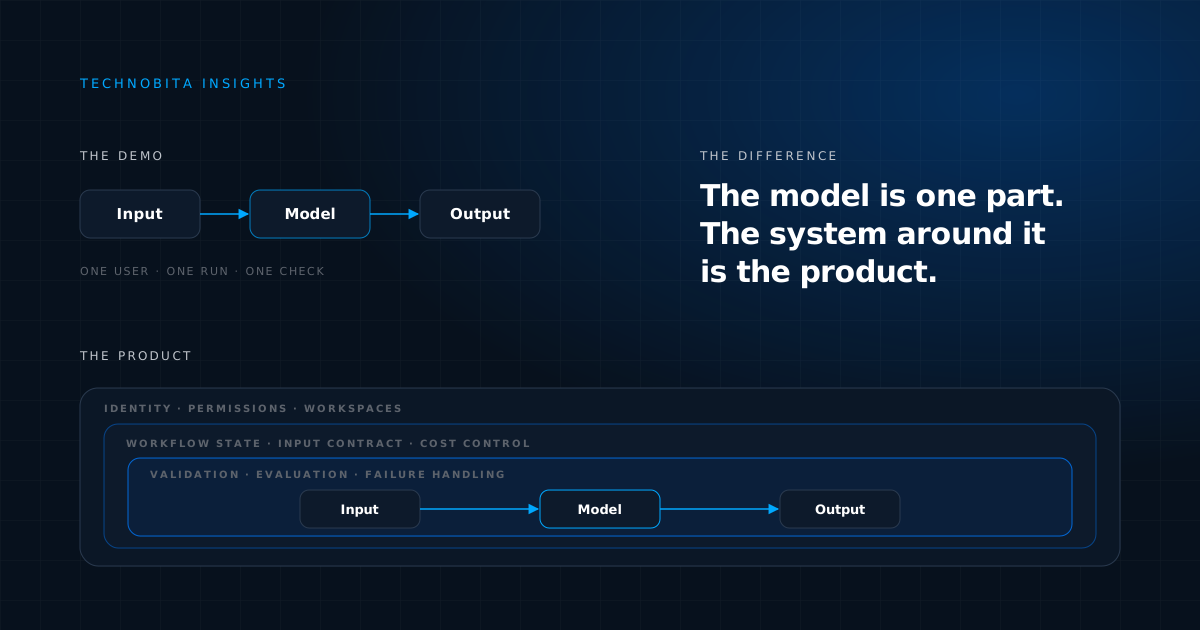
I have built AI demos in an afternoon that made people lean forward. A text box, a model call, a nicely formatted answer. Everyone in the room could see the potential. Then came the question that always comes: so when can we launch this?
That question is where the real work starts. The demo is the easy part. I do not say that to discourage anyone. I say it because the gap between a working demo and a working product is the most misunderstood part of building AI software, and misunderstanding it is how budgets, timelines and sometimes whole companies go wrong.
At Technobita we build our own AI SaaS products and we build them for clients. Every one of them started as something that looked like a demo. What follows is what I have learned about why the demo is easy, where the difficulty actually lives, and how we cross the gap on purpose instead of by accident.
What a demo actually proves
A demo proves one thing. It proves that a capable model, given a reasonable input, can produce an impressive output at least once. That is genuinely useful information. It tells you the idea is not impossible.
But look at what the demo is allowed to assume. It assumes the input is clean, because you typed it yourself. It assumes the user is you, so there is no question of who is allowed to see what. It assumes the answer is correct, because you looked at it and nodded. It assumes the cost does not matter, because it ran once. It assumes nothing went wrong, because if something had gone wrong you would have refreshed the page and tried again.
A product cannot assume any of those things. A product is the demo with every assumption removed and replaced with a system that handles the real case. That is the whole difference, and it is a large one.
The model is one part of the product. The product around the model determines whether people can actually rely on it.
The product around the model
When we scope an AI SaaS project, I ask the team to list everything the demo did not have to do. The list is always long and it is always roughly the same. These are the things that turn a model call into software people can use.
- Identity and permissions. Who is this user, which workspace do they belong to, and what are they allowed to see and change?
- Workflow state. Where is this piece of work in its lifecycle? Draft, generated, reviewed, approved, published? A demo has no lifecycle. A product is mostly lifecycle.
- Input contracts. What happens when the input is empty, enormous, in the wrong language, or contains something the model should not act on?
- Structured output. The model has to return something the application can validate and store, not a paragraph a human has to interpret.
- Validation. What does the application do when the output does not match the contract? Retry, fall back, ask the user, or refuse?
- Failure handling. The model API will time out. It will return something strange. It will be slow on a Monday morning. The product has to stay usable through all of that.
- Cost control. Every call costs money. A product needs limits, visibility and a way to make expensive operations a deliberate choice.
- Evaluation. How do you know the feature is still good after you change the prompt, the model or the context? "It looked fine when I tried it" is not an answer.
Where the time really goes
People expect most of an AI product's effort to go into the AI. In our experience it is the opposite. The model call is usually a small, stable piece of code. The effort goes into the product logic that decides when to call it, what to send, what to do with the result and how to keep everything predictable around it.
Take Promptelligence, one of our own products. The demo version of it is simple to describe: send a rough idea to a model and get a better prompt back. The product version has to know which task type the user chose, which depth level they want, how to structure the output so it can be scored, how to score the before and after, how to apply a refinement in plain English without regenerating everything, and how to save the result so it does not vanish after one session. None of that is the model. All of it is the product.
The same pattern shows up in ReviewProof Studio. Generating a social post from a customer review is a one-line demo. Making sure the post only says what the review actually said, keeping the customer's words separate from the business owner's context, linking the output back to its source, and holding it in an approval state until someone with permission publishes it is a product. The generation is one link in a long chain.
This is the part I most want founders to internalise. If your plan allocates most of the time to "the AI part", the plan is probably wrong. Allocate most of the time to the system around it.
"It usually works" is not an evaluation strategy
The most dangerous phrase in AI product development is "it usually works". I have said it myself. It sounds like confidence but it is really an admission that nobody has measured anything.
A demo is judged by one person looking at one output. A product is judged by every user looking at every output. The failures that were invisible in the demo become support tickets, lost trust and cancelled subscriptions. And because model behaviour is probabilistic, the failures do not announce themselves. The feature can get quietly worse after a prompt tweak or a model update and nobody notices until a customer does.
So before we call an AI feature done, we want an answer to three questions. What does a good output look like, specifically? How often does the feature produce one, measured on inputs that look like real usage rather than the three examples we tested with? And what does the product do when it produces a bad one?
The third question matters more than people expect. A feature that fails one time in twenty is fine if the product catches the failure and handles it gracefully. The same feature is a disaster if the failure goes straight to the user as if it were correct.
A feature that fails occasionally is fine if the product catches it. The same feature is a disaster if the failure reaches the user looking like a success.
What happens when the AI is wrong
Every AI product needs a clear answer to this question, because the AI will be wrong. Not might. Will.
In a demo, when the AI is wrong you shrug and try again. In a product, the wrong output might have been saved, shown to a customer, sent in an email or used to make a decision. The cost of the mistake depends entirely on how much authority the system gave the model.
This is why we design the boundary between AI and software deliberately. The model interprets, generates, classifies and suggests. The application controls identity, ownership, workflow state, what counts as valid, and what becomes visible or irreversible. When the model is wrong inside that boundary, the damage is contained. The output is marked invalid, or held for review, or the user is asked to confirm. When there is no boundary, the wrong output just flows through.
A practical rule we use: the closer an action is to durable truth or to something irreversible, the more human control belongs in front of it. Generating a draft needs little. Publishing to a customer's website needs a person and a permission state.
AI features also need a cost model
Demos are free in the sense that nobody is counting. Products are not. Once real users are generating real volume, the shape of your model usage becomes a business question.
We think about this early because it changes design decisions. Which operations should run automatically and which should be a deliberate click? Is there a cheaper model that is good enough for the simpler jobs? Can context be cached instead of rebuilt every time? Should the user be able to choose how much depth they want, and therefore how much it costs, the way Promptelligence does with its enhancement levels?
None of these questions can be answered in a demo because the demo has no users and no volume. They have to be answered in product design, and answering them late usually means rebuilding something.
How we cross the gap on purpose
None of this means AI products are not worth building. It means the path from demo to product should be designed rather than hoped for. Here is the sequence we follow, both for our own products and for client work.
- Define the AI's job in one sentence. Not "add AI", but "turn a rough idea into a structured prompt for the chosen task type". If you cannot write that sentence, you are not ready to build the feature.
- Define the workflow around the job. What comes before the model call, what comes after, and what state does the work move through?
- Define the output contract. What structure must the model return, and what does the application do when it does not?
- Decide what stays under software control. Identity, permissions, state, validation and anything irreversible.
- Build the evaluation alongside the feature, not afterwards. Collect realistic inputs, define what good looks like, and measure it before and after every change.
- Put a cost model in from the start, even a rough one, so volume does not surprise you later.
- Ship the smallest version that completes the whole loop, then improve it from real usage.
If you are planning an AI product
If you are a founder or a business leader with a working demo, I would say this. The demo has done its job. It told you the idea is possible. Do not confuse it with being close to done.
Budget and plan for the product around the model. Expect that most of the engineering will go into workflow, data, validation, permissions and reliability rather than into prompts. Treat evaluation as a feature, not a chore. Decide early what the AI is allowed to decide and what it is not. And do not let anyone, including yourself, say "it usually works" without numbers behind it.
The teams that get this right are not the ones with the cleverest prompts. They are the ones that understood that the model was one part of a system, and built the system.
A useful AI capability becomes a product only when the system around it can support real users, real workflows and real decisions.
Related work
Related services