
Building Accountability Without Employee Surveillance: Lessons From BossBoard
Owners want to know who they can rely on. Monitoring software answers the wrong question. The product decisions behind BossBoard, and what they teach about building software around people and responsibility.
Every small business owner I have spoken to about their team asks some version of the same question. Who can I actually rely on? Not who is busy, not who is online, not who marks tasks as done. Who completes work properly, consistently, without me checking every time?
The software industry has mostly answered that question with surveillance. Screen recording, activity tracking, keystroke counts, idle-time alerts. I understand why those products exist. The owner's question is real and the tools promise an answer. But they answer a different question. They measure activity, not quality. And they do it by damaging the one thing a small team runs on, which is trust.
BossBoard is our attempt to answer the owner's actual question without watching anyone. This article is about the decisions that made that possible, why each one mattered, and what I think they teach about building software around people and responsibility in general.
Why surveillance answers the wrong question
Monitoring software tells you that someone was active for seven hours and opened the right applications. It cannot tell you whether the work they produced followed the procedure, met the standard or needed to be redone. A person can be fully active and consistently produce poor work. Another can be invisible to the tracker and be the most dependable member of the team.
There is a second problem that is harder to measure and more damaging. People who know they are being watched behave like people who are being watched. They optimise for looking busy. They stop raising problems. The best ones, the ones with options, leave. The tool that promised accountability quietly produces the opposite: a team that performs for the camera and hides everything else.
So we started from a different premise. The owner does not need to see the person working. The owner needs to see the work, and needs a fair way to judge it, and needs to see the pattern over time. Build that, and the question answers itself.
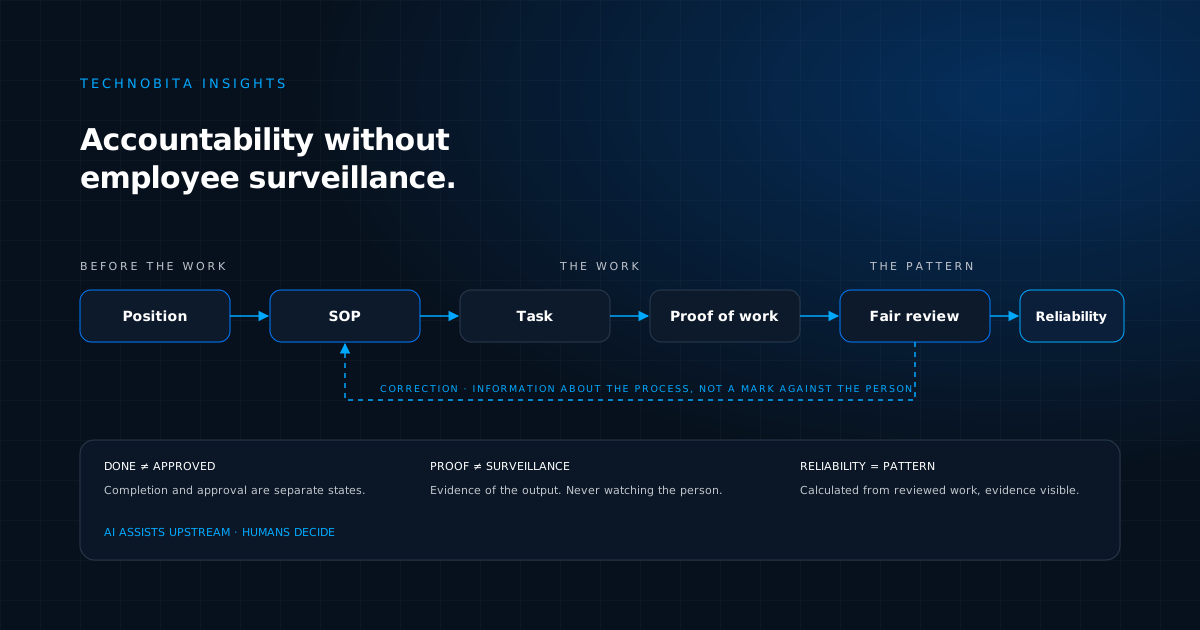
Done does not equal quality. Fair accountability starts before the work. Reliability is a pattern. None of it requires surveillance.
Accountability starts before the task
The first decision was about timing. Most tools judge work after it is done. We decided accountability has to begin before the task exists.
If nobody defined what good looks like, judging the result afterwards is unfair to the person and useless to the owner. The staff member did their best interpretation of a vague instruction. The owner is unhappy with the outcome. Neither of them can point to the standard that was missed because there was no standard.
In BossBoard, a task cannot exist on its own. It is assigned against a position and linked to an SOP, a standard operating procedure that describes how the work should be done. The expectation is set before the work starts. When the review happens later, it is a review against something specific that both people could see from the beginning. This single structural rule removed most of the unfairness that makes accountability feel like blame.
It also changed what an SOP is. In most businesses an SOP is a document in a folder that nobody reads. When the SOP is attached to the task, it participates in execution. It is the thing the person is working from and the thing the reviewer is checking against. The document becomes part of the workflow instead of sitting next to it.
Positions are not people
The second decision was a data model decision that turned out to be a philosophy. Responsibility belongs to the position, not to the person.
A business has a structure: departments, positions, the responsibilities each position carries. People fill positions. They also leave, go on holiday, get promoted or cover for each other. If responsibility is attached directly to a person, every one of those events corrupts the structure. The task history makes no sense. The org chart drifts out of date. Nobody can answer "whose job is this?" when the usual person is away.
Modelling the position separately from the person keeps the structure stable. The position owns the responsibility and the SOPs. The person currently in it does the work and is reviewed on it. When the person changes, the structure does not. When you look back at history, you can see both who held the position and what the position was expected to do. It is a small distinction with a large effect on fairness and on the long-term usefulness of the data.
Done is not approved
The third decision is the one that separates BossBoard from a task manager. Completion and approval are two different states.
When a staff member finishes a task, it is done. That is their honest statement that they completed the work. It is not yet approved. Approval happens when a reviewer looks at the proof, compares it to the SOP and makes a judgment. The two states exist separately in the product and the distinction is never blurred.
Task tools that collapse these into one tick are how the quality signal gets lost. Everyone marks everything done, the board turns green, and the owner has no idea what actually met the standard. Keeping the states apart is uncomfortable at first because it exposes the gap between finished and good. That gap is exactly the information the owner was missing.
Proof that serves the work
If the owner cannot watch the person, how do they know the work happened? The answer is proof, and the design of proof is where the surveillance line is most easily crossed.
Our rule is that proof belongs to the work output, never to the person's activity. A photo of the completed job, the file that was produced, a confirmation from the system the task was done in. Things that would be useful to the next step anyway. The product asks for evidence of the result. It does not take screenshots, track time or watch anything.
The difference is felt immediately by the people doing the work. Proof that helps the next person, or that protects you if there is a question later, is accepted. Proof that exists only to monitor you is resented. We tried to make every proof requirement pass the test of serving the work, and we built no capability for the other kind. There is no surveillance feature to turn off because there is no surveillance feature.
Proof belongs to the work, never to the person. There is no surveillance feature to turn off because there is no surveillance feature.
Fair review and corrections as information
A review is a judgment about someone's work, so it has to be fair, consistent and explainable. We gave reviewers a defined scoring model rather than a free-text opinion. The same kind of work is judged the same way, and the score can be explained in terms of the SOP it was measured against.
The more interesting decision was about what happens when work is not approved. In most systems that is a negative mark and nothing more. We made correction a first-class part of the loop. A correction records what was wrong, links back to the task and the SOP, and gives the person a path to fix it. It is stored as improvement information, not as a disciplinary record.
This turned out to be one of the most valuable signals in the product. Patterns in corrections point directly at unclear SOPs, missing training and badly defined tasks. If three different people get corrected on the same procedure, the problem is the procedure. An owner who only sees a score sees a people problem. An owner who sees corrections sees a process problem they can fix.
Reliability is a pattern, not a number
All of this feeds into the thing the owner originally asked for: who can I rely on? BossBoard answers it with a reliability signal, and the design of that signal is where we were most careful.
Reliability is calculated deterministically from reviewed outcomes over time. Not from activity. Not from self-reporting. Not from a model's opinion. Every contribution to the number is a specific review by a specific reviewer against a specific SOP, and all of that is visible underneath the number. The owner can see why. The staff member can see why. Nobody has to trust a black box.
We also resisted false precision. A score built from two reviews is not a meaningful judgment about a person, and presenting it as one would be dishonest. Reliability is shown as a pattern with its evidence attached, and when the evidence is thin, the product says so. Surfacing uncertainty is a feature. A confident number built on almost nothing misleads everyone and damages the person it is attached to.
Where AI fits, and where it does not
BossBoard is built by a company that builds AI products, so people assume AI is at the centre of it. It is not, and that was deliberate.
Judging a person's work and calculating their reliability are consequential decisions about human beings. We keep those with people and with deterministic rules, for all the reasons above. Explainability, fairness, accountability for the judgment itself. A model cannot be held responsible for a score, and someone has to be.
AI is most useful upstream, before anything consequential happens. Helping an owner draft a clear SOP. Flagging that a task description is ambiguous before it is assigned. Summarising a pattern in corrections so the owner can see it faster. These are planned capabilities and they stay labelled as planned until each one is verified in the product. But the direction is fixed. AI assists. Humans decide. The product would be worse, and in some ways harmful, if that were reversed.
What this teaches about building software around people
BossBoard is a specific product, but the lessons generalise to any business software that involves responsibility, judgment and trust.
- Define the expectation before the work, in a form that participates in the workflow rather than sitting beside it.
- Model responsibility on structure, not individuals, so the system stays correct when people change.
- Keep states apart when they mean different things. Done, approved and permitted are three states, not one tick.
- Collect evidence that serves the work, and refuse to collect evidence that only serves monitoring.
- Treat corrections and exceptions as information about the process, not marks against people.
- Calculate anything consequential deterministically, show the evidence underneath it, and surface uncertainty instead of hiding it.
- Put AI where it improves human decisions and keep it away from making them.
The owner's question, answered properly
The owner wanted to know who they can rely on. The surveillance answer gives them hours and screenshots and a team that no longer trusts them. The BossBoard answer gives them defined expectations, reviewed work, visible corrections and a reliability pattern that both they and their staff can see and explain.
It is a harder product to build. It took more structure, more careful state design and a lot of restraint about what not to build. But it answers the real question, and it does so without asking anyone to be watched. Understand the workflow. Define the responsibility. Build the missing system. Preserve the evidence. Automate carefully. Improve from real usage. That is how we build everything, and BossBoard is where we learned most of it.
Related work
Related services
Related insights
AI Automation
AI Should Assist the Workflow, Not Control Every Product Decision
The most reliable AI products give the model a defined job inside a workflow and keep the consequential decisions with software rules and people. How we draw that line, with lessons from BossBoard.
8 min read
Building Technobita Products
Generated Content Should Have Ancestry: What We Learned Building ReviewProof Studio
When AI generates content from customer evidence, every output needs a traceable line back to the proof it came from. The architecture decisions behind ReviewProof Studio and why we made them.
8 min read